


Why does someone with dementia keep asking the same question?
If you care for someone living with dementia, answering repeated questions can become part of daily life. Your loved one might often ask what time they’re leaving, where they’re going or when their daughter will arrive, for example – often over and over again.
The caring process can be tiring and draining even without the added challenge of repetitive questions. You may find yourself feeling frustrated on top of everything else, particularly when you’ve already answered the same question several times.
At this point, it helps to know that repeated questions are not usually deliberate. A person with dementia may genuinely forget that they’ve asked a question or that you’ve already answered it. From their perspective, they may be asking for the first time.
Understanding why this happens can make repetition easier to manage and help you respond in a way that reassures rather than causes further confusion.
Why do people with dementia repeat questions?
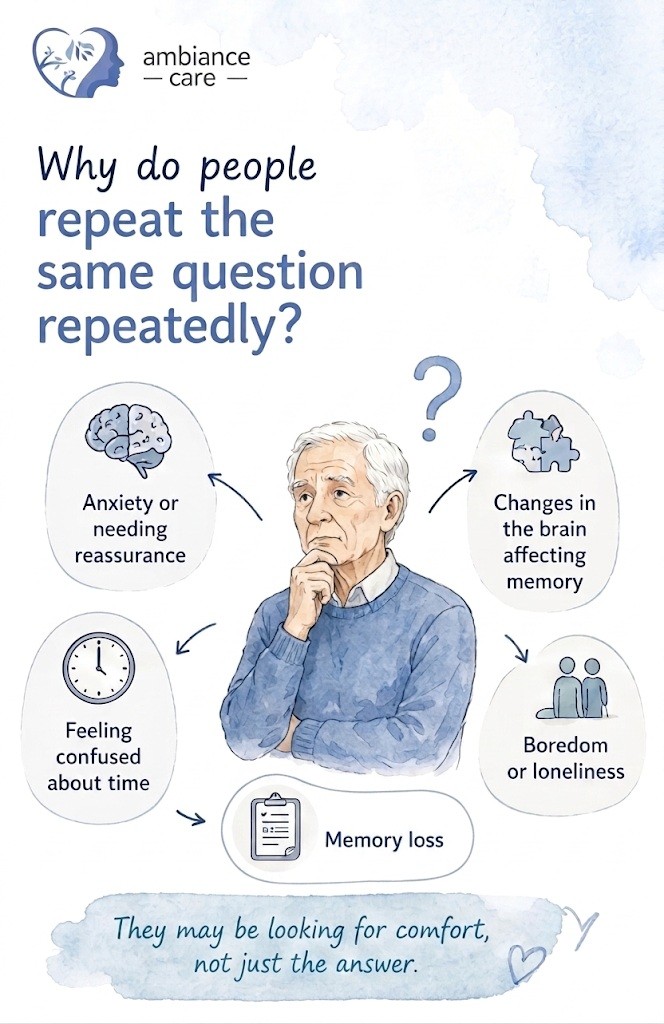 One of the most common reasons for repeated questions is short-term memory loss. Dementia can affect a person’s ability to retain new information, meaning they may forget a conversation soon after it’s happened.
However, repetition isn’t always about memory. It can also be linked to anxiety, confusion, boredom or a need for reassurance.
Someone repeatedly asking when their daughter is coming home might not actually be looking for information; they may be conveying something else that they can’t easily express, such as worry, loneliness or a need for reassurance.
Dementia can also affect a person’s understanding of time. They may struggle to remember whether something happened today, yesterday or several days ago, or find it difficult to understand how long they need to wait for something. This can make questions about appointments, visitors, meals and plans particularly common.
Changes to a person’s usual routine can also lead to more repetition. If something unexpected happens, they may repeatedly ask what’s going on as they try to make sense of the situation.
How should you respond?
It can be tempting to tell the person “I’ve already told you that!”, particularly when you’ve answered the same question again and again, but this can actually cause your loved one to repeat the question even more as their anxiety increases
Instead, we recommend trying to respond calmly and considering what might be behind the question.
Offer reassurance
If the person seems worried, try to address the feeling rather than simply repeating the facts.
If they’re repeatedly asking about an upcoming visit, they may be feeling worried and need reassurance that everything is okay rather than another explanation of the exact time.
A calm response and a reminder that they are safe and supported is often what’s required in these circumstances.
Keep your answers simple
People with dementia can find it difficult to process long or complicated explanations, so keep your answers short and clear, particularly if your loved one is already confused or anxious. Give them time to process what you’ve said rather than adding lots of extra information.
You may need to give the same answer several times. Try to remember that even though you’ve heard the question before, they may not remember hearing the answer.
Use visual reminders
A simple calendar, clock, whiteboard or written daily schedule can provide reassurance without the need for you to repeat the same information constantly. Instead, you could write down planned visits, appointments or activities for the day.
A note saying “Sarah is visiting today at 3pm” may help someone remember what’s happening and give them something to refer back to when they become unsure.
Keep reminders simple and easy to read – too much information can be overwhelming.
Look for patterns
Repeated questions may become more frequent at certain times of day or in particular situations. Keeping a note of when they happen can help you identify possible triggers, such as tiredness, hunger, boredom, unfamiliar surroundings or changes to routine.
You may notice that your loved one becomes more repetitive towards the end of the day, for instance. They may be tired or experiencing increased confusion. Understanding these patterns can help you anticipate when your loved one may need extra support or reassurance.
Redirect gently
Once you’ve acknowledged the question, try moving towards another activity. Looking through family photographs, listening to favourite music, making a cup of tea, doing some gardening or going for a walk can provide a positive distraction.
Activities don’t need to be complicated; something familiar and enjoyable can be enough to shift the person’s attention and give them a sense of purpose.
Consider what they might need
Sometimes, repeated questions can be a way of communicating an underlying need. Ask yourself whether the person could be hungry, thirsty, tired, uncomfortable or in need of the toilet. They may alternatively be looking for company or reassurance.
Thinking about what might be behind the question can help you respond to the actual need rather than focusing only on the repetition.
What if the repetition suddenly becomes worse?
If someone living with dementia suddenly becomes much more repetitive or confused than usual, it’s worth considering whether anything else could be contributing.
Changes in behaviour can sometimes be associated with physical illness, pain, dehydration, constipation, medication changes or other health problems.
If you notice a significant or sudden change from the person’s usual behaviour, it’s wise to seek medical advice rather than assuming it’s simply their dementia progressing.
Repeated questions can be challenging, particularly when you’re caring for someone day after day. It’s completely understandable to feel frustrated or tired after having the same conversation over and over again.
In these moments, try to remember that your loved one isn’t choosing to repeat themselves. They may have forgotten the conversation, be struggling to understand time, feel anxious about what’s happening or simply need reassurance.
At Ambiance Care, we understand that dementia affects the whole family. Our compassionate dementia homecare team supports families throughout the dementia journey, helping loved ones navigate the challenges that can arise along the way.
If you’d like advice about caring for someone living with dementia, call us on 0161 537 0983 or email enquiries@ambiancecare.co.uk.