

How to explain dementia to children
Dementia can be difficult to understand for people of all ages but especially so for children and young people. It isn’t always necessary or appropriate to go into scientific detail; what really matters is conveying the differences a young person might notice in their loved one with dementia, and explaining in simple terms what’s going on.
It’s common for children to have fears around dementia when they notice changes in a loved one’s memory or behaviour, and addressing these can put youngsters’ minds at ease. We’ve put together some useful tips and techniques for explaining dementia to children and teens, so they can develop an understanding and alleviate any worries.
Keep it simple
When speaking to children about dementia, use simple language they can understand. Focus on the changes they can see, such as repeating things or forgetting names, and talk to them about how these are the effects of the disease and not a fault of their loved one.
Use metaphors
Children might not be able to understand advanced concepts but they can relate to stories and analogies. Describing the illness as being like something else, such as a muddled library with books in the wrong places, can make dementia much easier for young brains to comprehend.
Reassure
Explaining to children and teens that dementia affects lots of people, that it’s nobody’s fault and that it’s not a contagious illness can provide reassurance and help to alleviate fears. Emphasising that your feelings haven’t changed for your loved one, and that your relative loves them, can provide comfort and calm if they’re experiencing any worries.
Reinforce
Although children may notice changes in their loved one, it’s helpful to reinforce that the person is still themselves at the core, even if their brain isn’t working in the same way anymore. Activities that stimulate your relative’s memory, such as looking over old photos or listening to their favourite songs, may help young people see their loved one at their best and know they’re still present.
Use resources
There are lots of resources available to help children and young people develop an awareness of dementia, including stories and books, videos and online animations. Making use of available resources is a great way to engage youngsters with interesting information designed for their level of understanding.
Welcome humour
Dementia is a serious disease but there are lots of funny moments to be found along the journey. Let children and teens know that it’s okay to find humour in silly moments and you might be surprised by how much laughter everyone shares together. Humour lightens the mood and makes everyone feel at ease.
For younger children (ages 3-6), try the following:
- Describe the brain as a library or computer: “Granddad’s brain is like a library and some books got mixed up, so he forgets things sometimes.” Or: “His brain is like a computer that’s a bit slow, so it’s hard to find things.”
- Focus on Love: For example, “even if Grandma forgets your name, she still loves you very much”.
For school-aged children (ages 6-12):
- Describe the brain as a recorder: “Your brain stores your memories like recordings but dementia makes it hard for the brain to play those recordings back sometimes.”
- Acknowledge changes: “You might have noticed Grandpa gets angry sometimes, but that’s his brain acting funny, not because he’s cross with you”.
For Teens:
- Honesty & detail: Teenagers can handle more complex explanations of dementia, so be honest in explaining the disease’s effects without overwhelming them.
- Address fears: Acknowledge that they might worry about getting dementia themselves, or have fears about their loved one person dying. Focus on present care and mitigate their concerns.
- Validate feelings: Let them know that it’s okay to feel sad, angry or confused and make them aware that you’re there to listen.
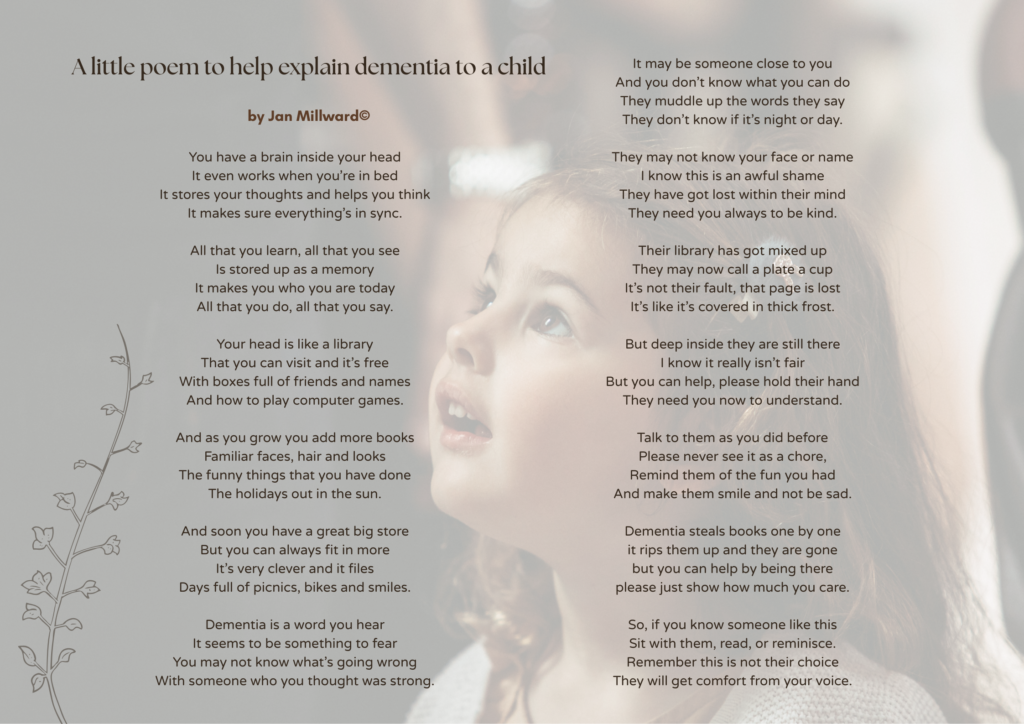
One of our favourite ways of explaining dementia to children is with this beautiful poem below by Jan Millward, which uses analogies to describe dementia to young people in ways they can relate to.
If you’d like any further advice, don’t forget that we’re just at the other end of the phoneline. Call Ambiance Advice on 0161 537 0983 or email us anytime and we’ll be happy to help.