

Dealing with challenging behaviour in dementia
Every dementia journey is different and it’s impossible to know in the early stages how each person who develops dementia will be affected. Some people living with dementia develop one of the more distressing symptoms of the disease: challenging or aggressive behaviour.
In this blog post, we’ll look at why this occurs, what’s meant by aggressive behaviour and how best to manage challenging symptoms.
How common is challenging behaviour in dementia?
Studies suggest that between 30% and 50% of people living with dementia will display some kind of aggressive or agitated behaviour at some point, although it’s significantly less common (just 13%) in the early stages.
Around a third of individuals with Alzheimer’s or frontotemporal dementia typically show signs of aggression towards others. In long-term care homes, challenging behaviour occurs in between 40% and 60% of residents with dementia.
What is challenging behaviour?
Challenging behaviour may be verbal or physical, ranging from angry outbursts of shouting, swearing, screaming or making threats to hitting others, biting, pulling hair or throwing things.
Aggression may be the result of a frustrating situation or may seem to come from nowhere but there is usually an underlying cause.
What causes aggression in dementia?
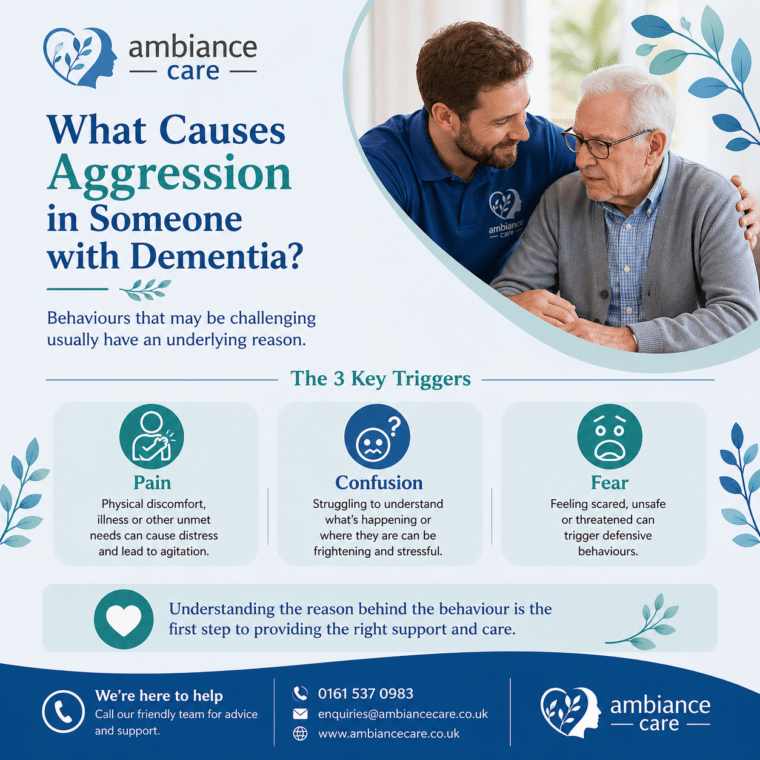
In some cases, hostility will have been part of an individual’s personality or behaviour before they developed dementia but it’s entirely possible for a person to develop aggressive behaviour. Changes to the brain from dementia progression can affect a person’s personality, even if they were not aggressive before.
Reasons for challenging behaviour in people with dementia include:
- Physical discomfort that they may not be able to communicate
- Mental health issues affecting their mood
- Orientation problems
- How often they have contact with another person or people and what this contact looks like
- Their surroundings, such as a lack of light, too much noise or stimulation
- Frustration at not being able to do the things they once could
- Feeling ignored or misunderstood
- Not being able to make sense of what’s happening around them
- Side effects of medication
How to manage challenging behaviour
Challenging behaviour is, in itself, a form of communication: it’s a person’s way of expressing that something isn’t right. Managing aggression means identifying triggers rather than responding with anger.
The best approach is one of reassurance and addressing anything that may be amiss, such as unmet physical or emotional needs, or challenges in the immediate environment.
- See things from the individual’s perspective in the context of where they were when they displayed this sort of behaviour. This may help identify what was going on at the time.
- Think about their personality. If they’ve always been independent, they may resent being assisted with things they could do before, like bathing or feeding themselves.
- Make sure they’re getting enough sleep. Being tired can cause anyone to feel grumpy or become easily overwhelmed, which can make hostility more likely.
- Create a calm environment that helps the person relax. Soft textures, familiar pictures and scents can all help relieve stress.
- Music can be medicinal. Help your loved one listen to music they enjoy or take part in making music through group activities or therapy. Use music to make challenging tasks like washing easier.
- Physical activity and exercise can burn off excess energy. Support the person in being active to boost their wellbeing and reduce the likelihood of agitation.
- Take them to visit the GP for a full health check. Look out for signs of discomfort like restlessness, a temperature, a change in appetite or mood, or repeatedly pulling at a particular body part.
How to respond in the moment
It can be distressing to witness a loved one displaying challenging behaviour. In the moment, how you react can affect how the situation unfolds.
- Stay calm. The person will respond to your own behaviour and communication. Step back to give them some space and if necessary, leave the room until you’re both feeling calmer.
- Offer reassuring words that show the person you acknowledge how they’re feeling. Try to support them emotionally and tell them they are safe.
- Maintain open body language that shows you want to help. Keep eye contact and gently encourage the person to communicate with you in their own time.
- Use distraction techniques to refocus their energy. Tell them about a recent experience you’ve had or get out the family photo album and go through pictures together.
- Don’t get too close during a challenging episode. Encroaching on someone’s personal space or trying to restrain them can seem threatening and escalate the situation.
- Stay safe. Seek help if necessary and speak to other agencies like the GP or social services to see how they recommend future management.
It’s helpful to remember that the person is struggling and their display of aggression is not a direct attempt at causing distress to others. More often than not, there are causes or triggers underlying the behaviour.
At Ambiance Care, we regularly care for people living with dementia who display difficult behaviour. We fully believe there are almost always ways of managing and responding without an individual being confined to a care home, because it’s something we see and do every day.
We’re here to help you and your loved ones navigate the dementia journey and all of its challenges – contact us for more advice or information.